

- by Jorge Mckechnie
- Massage Benefits, Massage Techniques, Massage Therapies, Massage treatments, Specialized Massage Therapies
- 0 Comments
Someone walks into a massage center, moving carefully, rotating their whole body rather than just turning their neck, sitting down slowly as if lowering themselves onto broken glass. And when I ask how long their back has been bothering them, the answer is almost always some version of: “Oh, a few months. I just figured it was part of getting older.”
It’s not.
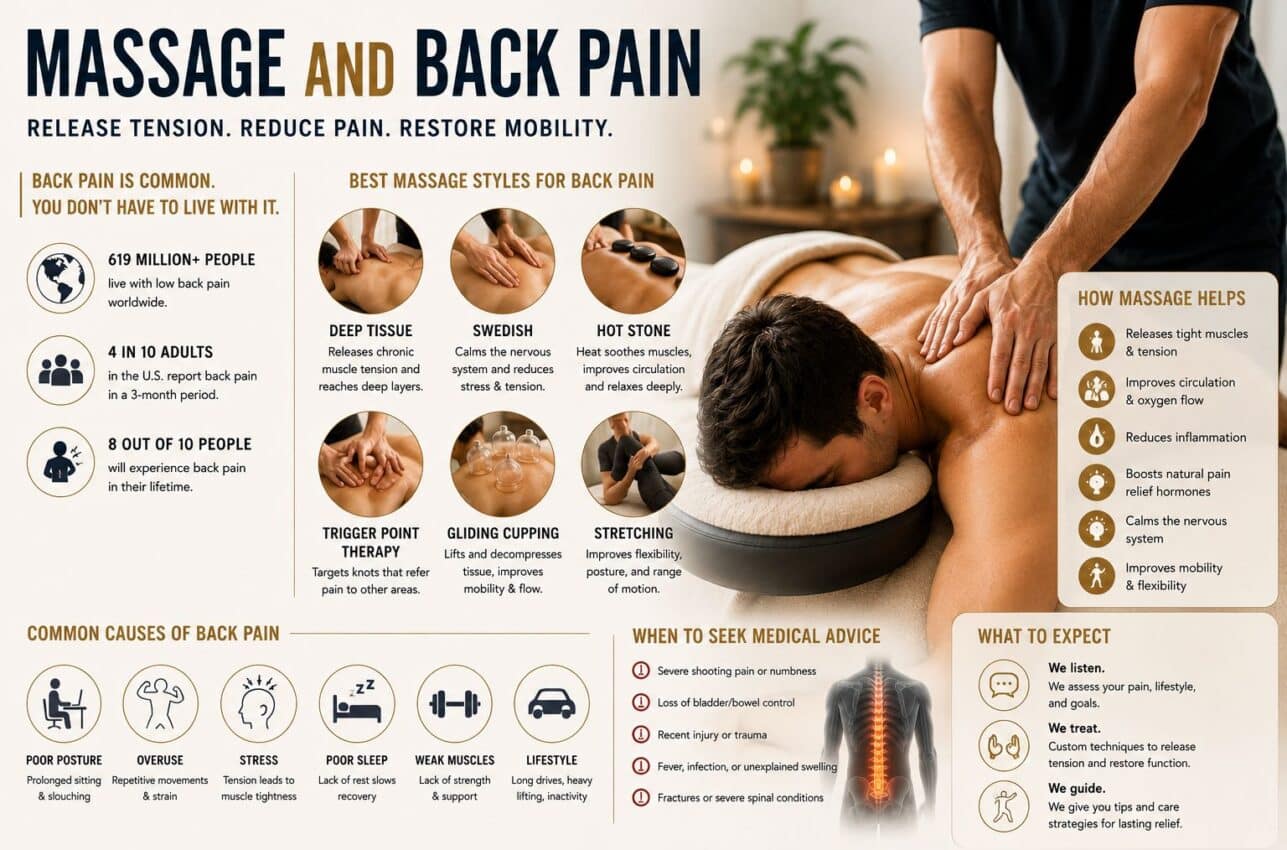
Back pain is one of the most common health conditions in the world — globally, over 619 million people live with low back pain, and it’s the single leading cause of disability worldwide. In the U.S. alone, nearly four in ten adults report back pain in any given three-month period. Eight out of ten people will deal with it at some point in their lives. So yes, it’s incredibly common, and it definitely doesn’t mean you just have to live with it.
Maybe it starts after long hours at a desk. Maybe it shows up after workouts, heavy lifting, parenting, commuting, or simply sleeping wrong one too many times. At first, it’s just stiffness. Then suddenly you notice you’re stretching constantly, shifting positions in your chair, or dreading the moment you stand up after sitting too long.
One of the most powerful tools available for back pain massage therapy is something people often underestimate because it sounds too simple. But the type of massage, the pressure, the timing, and the therapist all matter more than most people realize.
A good massage can help muscles release, improve mobility, reduce tension patterns, and calm an overloaded nervous system. A bad one can leave you more inflamed and irritated than before.
So let’s talk honestly about massage and back pain, what works, what doesn’t, and how to know whether massage is actually the right next step for your body.
Why Massage and Back Pain Are Such a Good Match
Your back is one of the most complex structures in your body — layers of large and small muscles, tendons, ligaments, and connective tissue all working together to keep you upright, mobile, and functional. When any part of that system gets overloaded — through prolonged sitting, poor posture, repetitive strain, stress, or just life — the whole chain tightens up. Massage treatment for back pain directly addresses soft tissue in a way that almost nothing else does.
When a skilled therapist works through the layers of your back, several things happen simultaneously:
- Tight muscles release — the sustained holding patterns that compress your spine and restrict your movement begin to soften
- Circulation improves — freshly oxygenated blood reaches areas that have been starved of it, while metabolic waste gets cleared out.
- Inflammation decreases — not overnight, but progressively over sessions
- Serotonin, dopamine, and endorphins increase — your body’s own pain management system gets activated
- Your nervous system downregulates — meaning your body moves out of the chronic stress state that keeps muscles locked tight
A study published in the Journal of the American Academy of Family Physicians found that people with back pain who received therapeutic massage experienced greater relief than those who received a placebo treatment. In another study, participants who received back pain massage therapy reported significantly less anxiety, pain, and depression compared to a group receiving muscle relaxation treatment alone. Over 40% of patients in a 104-person study saw long-term, meaningful improvement in both pain and disability after a series of massage sessions.
The Best Types of Massage for Back Pain
Deep Tissue Massage is often the first thing people reach for, and for good reason — when your back pain stems from chronic muscle tension, postural holding patterns, or repetitive strain, deep tissue work gets into the layers where the problem lives. Slow, firm strokes along the muscle fibers and sustained pressure on specific areas of tightness can produce relief that lighter techniques simply can’t reach.
Swedish Massage should never be dismissed for back pain. If your pain is linked to stress, tension that’s more surface-level, or you’re in a more acute phase where deep pressure would be too much, the long, flowing strokes of Swedish massage do something powerful: they calm your nervous system. And a calmed nervous system is a nervous system that will let your muscles release.
Hot Stone Massage adds a thermal dimension that’s genuinely useful for back pain. The heat from smooth basalt stones placed along either side of the spine (never on the spine itself) softens the muscle tissue, improves blood flow, and reduces the kind of chronic cramping and spasm that makes back pain so relentless. The warmth also reaches the sacrum and hips — areas that contribute enormously to lower back tension but often get overlooked.
Trigger Point Therapy is something I integrate into almost every back pain session. Most chronic back pain has trigger points — hypersensitive knots in muscles like the quadratus lumborum, gluteus medius, or piriformis — that refer pain up into the back or down into the leg. Releasing those points changes everything.
Gliding Cupping is particularly effective for the upper back and thoracic spine — the area between your shoulder blades that holds years of desk posture and stress. The lifting action of the cups creates a kind of decompression in the tissue that feels unlike anything else.
Lower Back Pain Specifically, What’s Actually Going On?
Lower back strain massage is one of the most common requests I get, and it deserves its own conversation because the lower back is complicated.
The muscles of the lumbar region — along with the hips, glutes, and even the hamstrings — function as an interconnected system. When your hamstrings are chronically tight, your lower back compensates. When your glutes are weak or overworked, your lower back compensates. When you sit for eight hours a day, every structure in that chain gets compressed and restricted.
Treating only where it hurts, without addressing what’s causing it, is why so many people get temporary relief but keep coming back to the same pain.
For structural issues like disc herniations or nerve compression, massage supports recovery alongside other treatment but isn’t a standalone fix. Knowing the difference is important, which is why we always talk before we work.
Common Mistakes People Make When Managing Back Pain
Waiting too long. The longer tension patterns settle in, the harder they are to unwind. If your back has been tight for six months, it’s going to take more than one session to undo that. Starting sooner always pays off.
Only stretching the painful spot. If your lower back hurts, stretching only your lower back ignores the hips, hamstrings, and glutes that are usually the real culprits.
Assuming more pressure always helps. Aggressive pressure on an inflamed or acutely injured area can make things significantly worse. There’s a time for deep work and a time for gentle, calming techniques — and a good therapist knows the difference.
Sitting through it. Prolonged sitting is one of the biggest contributors to low back pain in the modern world. No amount of massage can counteract eight hours of unbroken sitting at a desk. Movement breaks matter.
When Massage Should Be Avoided
You should be cautious or seek medical guidance if you have:
- Severe shooting pain
- Numbness or tingling
- Recent acute injury
- Fever or infection
- Unexplained swelling
- Fractures
- Severe spinal conditions
- Certain inflammatory disorders
A good therapist knows when massage is appropriate and when referral out is smarter.
What to Expect at a Back Pain Massage Session at Cielo
I want to know when your back pain started, what makes it worse, whether it radiates anywhere, what you’ve already tried, and what your daily life looks like — because all of that shapes the session.
From there, we work in layers. We warm the tissue, listen to how your body responds, and adjust as we go. The session might blend Swedish strokes with targeted trigger point work and some cupping on the upper thoracic area — or it might be primarily deep tissue on the lumbar region with heat applied first. It depends on you.
After your session, we’ll talk about what we found and what to do next — whether that’s coming back in a week, doing some specific stretches at home, or adjusting how you’re sitting at your desk.
We’re located at 131 N 4th St in Old City, Philadelphia — and we also offer mobile massage if getting to us on a bad back day sounds impossible. Ready to give your back the attention it’s been asking for? Book your session or call +1 (347) 665-6263.
FAQs
Can a massage help with lower back pain?
Yes, for most cases of lower back pain that stem from muscle tension, postural strain, or repetitive stress, massage therapy is a well-supported treatment. Research shows that therapeutic massage can reduce pain, decrease muscle stiffness, improve range of motion, and lower anxiety associated with chronic pain. It works best as part of a broader self-care approach rather than a one-time fix.
What type of massage is best for back pain?
It depends on the cause. Deep tissue massage works well for chronic muscle tension and postural holding patterns. Swedish massage is better when the nervous system is overactivated or the pain is more acute. Hot stone massage helps with muscle spasm and chronic tightness. Trigger point therapy is ideal when specific knots are referring pain. Many sessions blend several of these approaches.
How many massage sessions does it take to relieve back pain?
For recent or mild back pain, one to three sessions often produce meaningful improvement. For chronic back pain that has built up over months or years, a series of six to eight sessions — typically weekly or biweekly — tends to be more effective, followed by monthly maintenance. Consistency matters more than frequency.
What's the difference between massage for upper back pain vs. lower back pain?
Upper back pain often involves the thoracic spine, rhomboids, and trapezius muscles — commonly driven by shoulder tension, poor posture, and stress. Lower back pain typically involves the lumbar muscles, glutes, hip flexors, and hamstrings. Treatment approaches differ: the upper back often benefits from cupping and trigger point work; lower back benefits from a fuller-chain approach that includes the hips and glutes, not just the lumbar region.
Book your massage appointment with Jorge McKechnie today.