


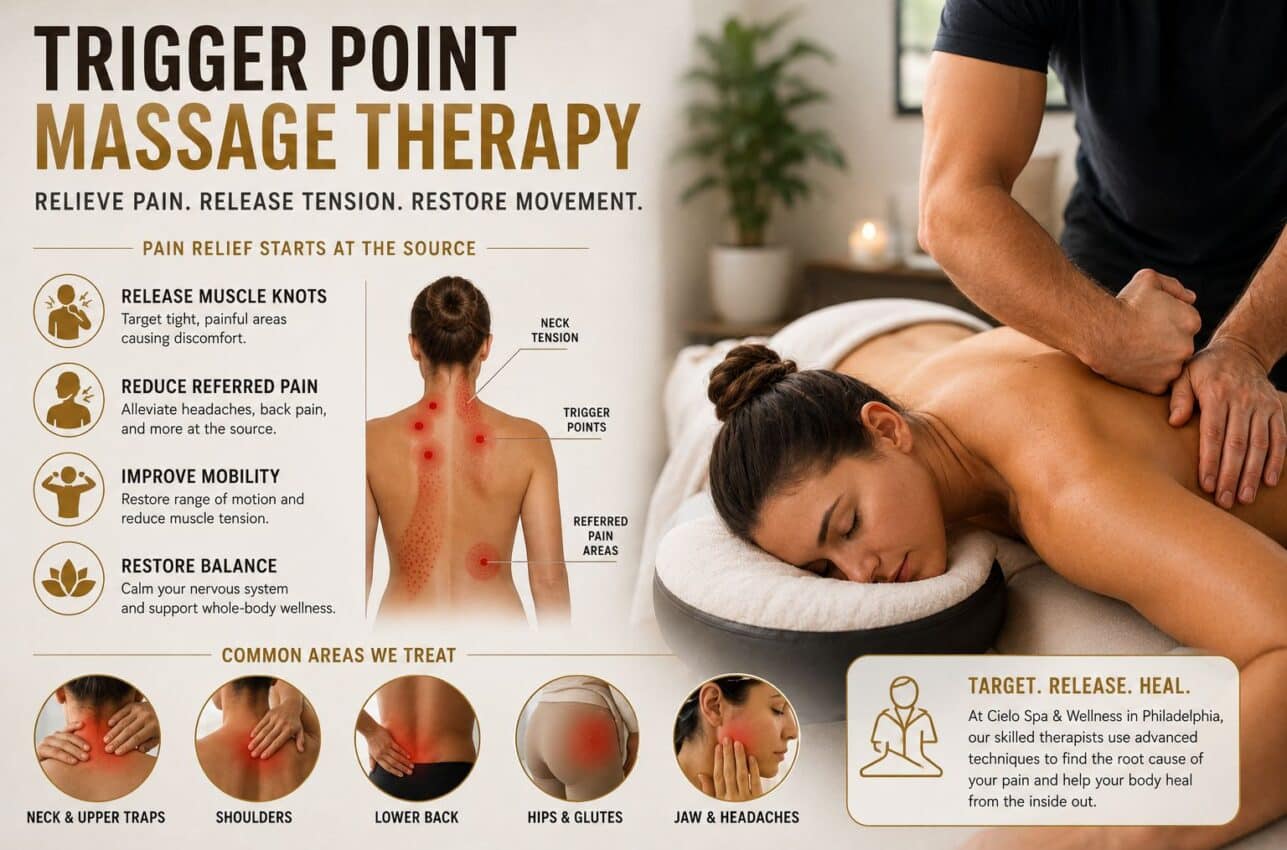
If you’ve ever had a stubborn knot in your neck or shoulders that just would not go away, no matter how much you stretched. You know that spot. The one that’s been there for weeks — maybe months. That tight, almost burning little lump sitting right between your shoulder blades and spine. You press on it, and it hurts, but somehow it also feels right to press. Your neck turns, and you feel it pull. You’ve tried stretching, you’ve tried heat pads, maybe you’ve even asked someone to just dig their elbow into it while you wince.
That spot? It’s called a trigger point — and it’s doing a lot more damage than you probably realize.
At Cielo Spa & Wellness in Philadelphia, trigger point work is one of the most requested treatments we offer — and honestly, it makes sense. Modern life keeps people tense. Long hours at a desk, workouts without proper recovery, stress, poor posture, old injuries… it all adds up.
What surprises most clients is that the pain they feel is not always coming from the place they think it is.
That headache? Could be coming from tight muscles in your neck.
That lower back pain? Sometimes it starts in the hips.
That shoulder tension? Often connected to trigger points buried deep in the upper trapezius muscles.
What Is Trigger Point Massage Therapy?
Trigger points are tight, irritated areas inside muscle tissue — commonly called “muscle knots.”
These areas become sensitive, inflamed, and restricted over time. When pressure is applied, they can create pain both locally and in completely different parts of the body. This is called referred pain.
For example:
- Trigger points in the neck may create headaches
- Shoulder trigger points can send pain into the arms
- Hip tightness may contribute to lower back discomfort
- Jaw tension can create facial pain or migraines
This is why trigger point therapy Philadelphia clients often come in for one issue and discover the actual source somewhere else entirely.
A professional deep tissue trigger point massage focuses on identifying and releasing these restrictions carefully through sustained pressure, stretching, and muscle manipulation.
At Cielo Spa & Wellness, trigger point work is often combined with:
- Deep tissue massage
- Myofascial release
- Stretching techniques
- Relaxation massage
- Mobility-focused bodywork
The goal is simple: reduce pain, restore movement, and help the nervous system calm down.
Why Muscle Knots Happen in the First Place
Most people do not wake up one morning with severe muscle tension out of nowhere. Knots usually build gradually over time.
Some of the most common causes include:
Poor Posture
Philadelphia office workers are a huge example of this. Sitting hunched over laptops for 8–10 hours daily creates constant strain on the neck, shoulders, and upper back.
Stress & Anxiety
Stress keeps the body in a semi-contracted state. Many people unconsciously tighten their shoulders or clench their jaw throughout the day.
Overuse Injuries
Athletes, gym-goers, hairstylists, nurses, drivers — repetitive movement patterns create chronic muscle overload.
Previous Injuries
Old injuries often create compensation patterns where other muscles work overtime to protect the body.
Lack of Recovery
Not stretching, poor sleep, dehydration, and lack of mobility all contribute to muscular tension.
Over time, these tight areas stop relaxing properly. Blood flow decreases. Irritation increases. That’s when trigger points become painful.
How Does a Trigger Point Session Actually Work?
Trigger point therapy is rarely a standalone treatment from start to finish. In practice, it gets woven into a larger session — often alongside deep tissue trigger point massage or myofascial techniques — because the surrounding muscle tissue needs to be warmed up and prepared before we go after those tight spots directly.
During a session, I’ll use my fingers, thumbs, or sometimes my elbow or forearm to locate the trigger point and apply what’s called ischemic compression — steady, focused pressure held for several seconds until the tissue begins to soften and release. Some clients describe it as a “good hurt” — that sensation of tension finally giving way. Others feel a referred pain pattern light up briefly before it fades. Both are completely normal signs that the therapy is working.
The technique might also include:
- Pincer compression — gently gripping the tissue between thumb and fingers
- Tissue rolling — slowly working across the muscle fibers to find and release active points
- Integrated myofascial work — addressing the connective tissue around the trigger point to prevent it from locking back up
One session can make a meaningful difference. But for chronic, longstanding trigger points — especially ones that have been building for months — a consistent series of sessions tends to produce the most lasting results.
Who Benefits Most from Trigger Point Therapy?
Desk workers and remote professionals. Hours hunched over a laptop create exactly the kind of sustained holding patterns that breed trigger points in the neck, upper traps, and rhomboids. If your workday ends with a tight neck and a dull headache, trigger points are almost certainly involved.
Athletes and active individuals. Repetitive movements — whether you’re a runner, a cyclist, a weekend gym-goer, or a martial artist — overload specific muscles over and over. Deep tissue trigger point massage is incredibly effective for addressing sports-related tightness and speeding up recovery.
People with chronic pain. If you’ve been living with nagging muscle pain that never fully resolves — pain that’s been there so long it just feels “normal” — trigger points may be the underlying driver that’s been missed.
Anyone dealing with tension headaches or jaw pain. Trigger points in the suboccipital muscles (base of the skull), the temporalis, and the upper traps are some of the most common — and most underappreciated — contributors to recurring headaches.
People recovering from injuries. Whether it’s a car accident, a work injury, or a sports strain, trigger points often develop as a protective response around the injured area and can persist long after the original injury has healed.
Trigger Point Therapy vs. Deep Tissue Massage — What’s the Difference?
This question comes up constantly, so let me break it down simply.
Deep tissue massage uses slow, firm strokes across broad areas of muscle to release overall tension in deeper muscle layers. Think of it as working across a large territory with sustained pressure.
Trigger point therapy is more like surgical precision. Instead of broad strokes, it zeroes in on specific, identifiable points of dysfunction — holds them, releases them, and moves to the next one. The pressure can be intense, but the contact is more static than flowing.
In practice, a skilled therapist — like the team at Cielo — will blend both. We use deep tissue trigger point massage as an integrated approach: broad strokes to warm up the tissue, targeted trigger point work to address the root problem, and myofascial techniques to restore flexibility around the area. It’s the right tool at the right moment.
What to Expect at Your First Session at Cielo Spa & Wellness
Before we even start, we talk. I want to know where your pain is, how long it’s been there, what makes it worse, and what you’ve already tried. That conversation shapes everything about your session.
From there, we move into assessment — finding where the actual trigger points are, which isn’t always where the pain feels loudest. I’ll check your range of motion, feel for tension patterns, and map out a plan for the session.
Treatment itself is focused and purposeful. You’ll likely feel pressure that ranges from mild to intense, depending on the point — I always check in with clients to make sure we’re in that productive discomfort zone without tipping into unnecessary pain. The goal is release, not suffering.
After your session, some mild soreness for 24–48 hours is normal and actually a good sign. Drink plenty of water, take it easy on intense activity that day, and pay attention to how your body responds over the next few days. Most clients notice meaningful improvement within 1–3 sessions for acute issues, and consistent improvement over time for chronic conditions.
We’re located at 131 N 4th St in Old City, Philadelphia — easy to reach whether you’re coming from Center City, Northern Liberties, or across the river. Book your session with the experienced therapists at Cielo Spa & Wellness in Philadelphia today.
FAQs
What is trigger point massage therapy, and how does it work?
Trigger point massage therapy targets hyper-contracted bands of muscle tissue — commonly called "knots" — by applying sustained, focused pressure to specific points. This interrupts the muscle's pain signal, increases local blood flow, and encourages the tissue to release. It also addresses referred pain, where tightness in one area causes symptoms somewhere else entirely.
How is trigger point therapy different from a regular massage?
A regular relaxation massage uses flowing strokes across broad muscle groups. Trigger point therapy is more precise — it locates specific painful nodules within the muscle and holds targeted pressure on those exact points until they release. It's often integrated into a session alongside deep tissue or myofascial techniques rather than used in isolation.
Is trigger point therapy painful?
There's typically a "productive discomfort" sensation — pressure that feels intense but purposeful, sometimes with a brief referred pain response as the point releases. A skilled therapist will always work within your tolerance. It should never feel like unnecessary suffering. Mild soreness for 1–2 days after is normal and a sign your body is responding.
How many trigger point therapy sessions will I need?
For acute, recent muscle tightness, one to three sessions often produce significant improvement. For chronic trigger points that have been present for months or years, a consistent series of sessions — typically every 1–2 weeks initially — tends to give the most lasting results. Everybody is different.
What's the difference between trigger point therapy and myofascial release?
Trigger point therapy uses sustained compression on specific painful nodules within a muscle. Myofascial release works on the connective tissue (fascia) surrounding the muscles using slow, stretching shear pressure across the skin's surface. Both target pain and tension but through different mechanisms — and at Cielo, we often combine both for a more comprehensive result.
Book your massage appointment with Jorge McKechnie today.